

nvesting in geotechnical and environmental software—whether for data management, borehole logging, or automated reporting—is a major decision. While features and pricing are important, the most critical question is:
👉 What return will this investment deliver?
Return on Investment (ROI) provides a clear, measurable way to evaluate whether software will actually improve your business outcomes—not just your technology stack.
For engineering firms, ROI is driven by:
- Time savings
- Reduced errors
- Improved data management
- Faster reporting
- Increased project capacity
This guide breaks down how to calculate ROI for geotechnical and environmental software, including practical formulas, examples, and best practices.
What Is ROI in Engineering Software?
ROI (Return on Investment) measures the financial return gained from an investment relative to its cost.
Basic ROI Formula:
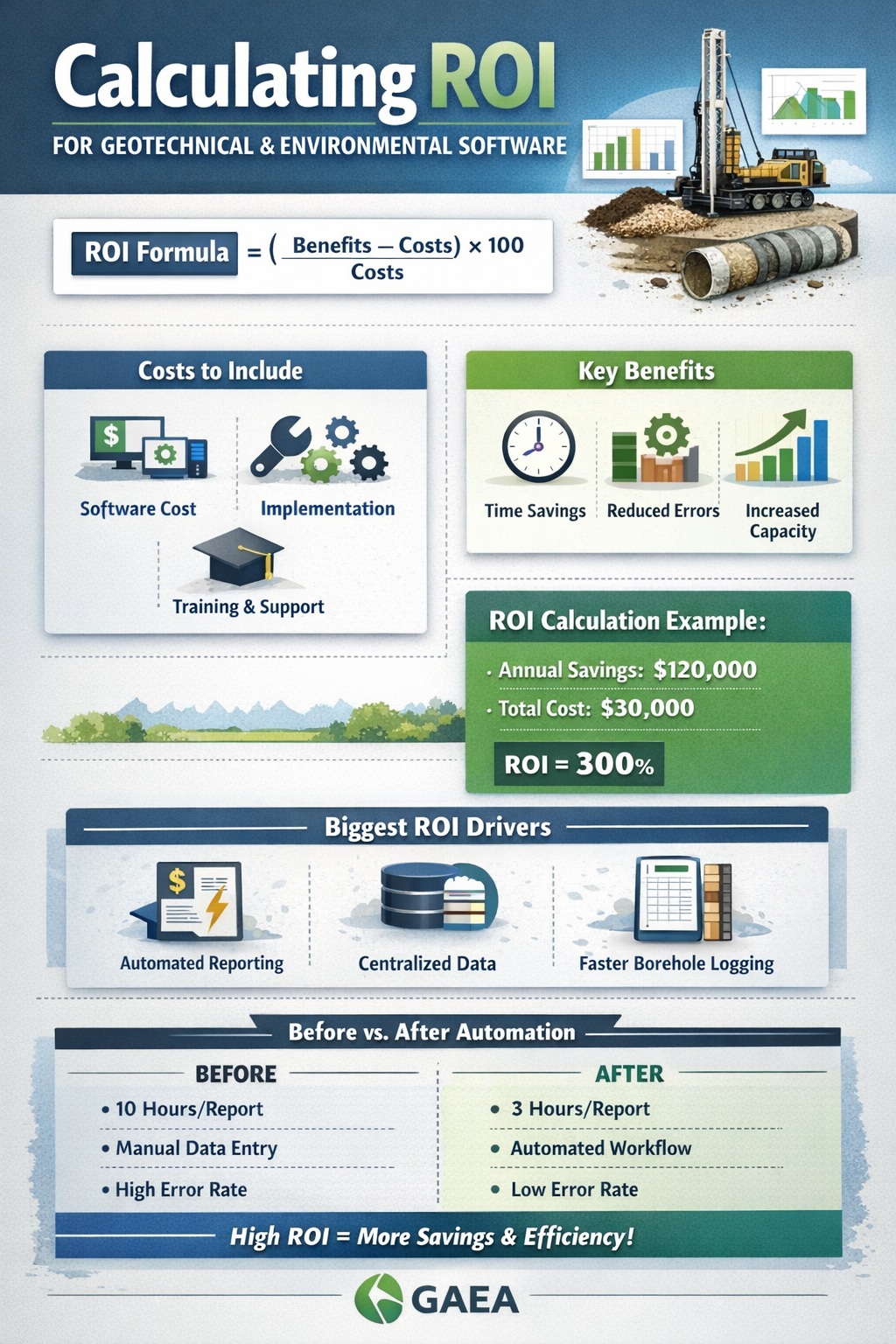
ROI (%) = ((Benefits – Costs) ÷ Costs) × 100
In the context of geotechnical and environmental software:
- Costs = software purchase + implementation + training + maintenance
- Benefits = time savings + reduced labor + fewer errors + increased revenue
Why Is ROI Important for Software Decisions?
1. Justifies Investment
ROI helps you:
- Build a business case
- Secure management approval
2. Compares Software Options
Two tools may have similar features—but very different ROI.
3. Identifies True Value Drivers
ROI highlights what really matters:
- Efficiency
- Automation
- Data quality
4. Supports Long-Term Planning
Understanding ROI helps align software with:
- Growth goals
- Operational strategy
What Costs Should Be Included in ROI Calculations?
1. Software Costs
- License or subscription fees
- Additional modules
2. Implementation Costs
- Setup
- Configuration
- Data migration
3. Training Costs
- Initial training
- Ongoing onboarding
4. Infrastructure Costs
- Servers or cloud hosting
- IT support
5. Ongoing Maintenance
- Support contracts
- Updates
What Benefits Should Be Included in ROI?
1. Time Savings
One of the largest ROI drivers.
Examples:
- Faster borehole logging
- Automated reporting
- Reduced data entry
2. Labor Cost Reduction
Less time spent means:
- Lower labor costs
- Ability to handle more projects
3. Error Reduction
Fewer errors lead to:
- Less rework
- Lower risk
4. Increased Project Capacity
Efficiency allows firms to:
- Complete more projects
- Increase revenue
5. Improved Data Quality
Better data leads to:
- Better decisions
- Stronger compliance
How Do You Calculate ROI Step-by-Step?
Step 1: Calculate Total Costs
Example:
- Software: $10,000/year
- Implementation: $15,000
- Training: $5,000
👉 Total Year 1 Cost = $30,000
Step 2: Calculate Annual Benefits
Example:
- Time saved per report: 5 hours
- Reports per month: 20
- Hourly rate: $100
Annual Savings = 5 × 20 × 12 × 100
👉 Annual Savings = $120,000
Step 3: Apply ROI Formula
ROI = ((120,000 – 30,000) ÷ 30,000) × 100
👉 ROI = 300%
What Are the Biggest ROI Drivers in Geotechnical and Environmental Software?
1. Reporting Automation (E-ASR)
- Reduces report generation time by up to 70–90%
- Eliminates repetitive formatting
2. Centralized Data Management (EDMS)
- Eliminates duplicate data entry
- Improves accuracy
3. Borehole Logging Efficiency (WinLoG)
- Faster log creation
- Standardized outputs
4. Integrated Workflows (GDMS + EDMS)
- Seamless data flow
- Reduced manual handling
How Does Workflow Automation Impact ROI?
Automation transforms ROI by reducing manual effort.
Before Automation:
- Manual data entry
- Repetitive reporting
- High error rates
After Automation:
- Centralized data
- Automated outputs
- Faster workflows
Result:
- Lower costs
- Higher productivity
- Increased profitability
How Do You Calculate ROI for Reporting Automation?
Example Scenario:
- Manual report time: 10 hours
- Automated report time: 3 hours
- Time saved: 7 hours
Annual Impact:
Savings = 7 × Reports × Hourly Rate
For 20 reports/month at $100/hour:
👉 $168,000 annual savings
How Does Data Management Affect ROI?
Fragmented Systems
- Duplicate data entry
- Higher error rates
- Increased labor
Centralized Systems
- Single source of truth
- Reduced duplication
- Faster reporting
ROI Impact:
- Lower operational costs
- Improved efficiency
How Do You Factor in Hidden ROI Benefits?
1. Reduced Risk
- Fewer compliance issues
- Better audit readiness
2. Improved Client Satisfaction
- Faster delivery
- Higher quality reports
3. Scalability
- Ability to grow without increasing staff
How Long Does It Take to See ROI?
Typical timelines:
- Quick wins: 1–3 months
- Full ROI: 6–12 months
What Is a Good ROI for Engineering Software?
General benchmarks:
- 100% ROI → Break-even
- 200–300% ROI → Strong investment
- 300%+ ROI → High-impact solution
What Mistakes Should You Avoid?
1. Ignoring Time Savings
Time is the biggest ROI driver.
2. Underestimating Adoption
Low adoption reduces ROI.
3. Excluding Hidden Costs
Include:
- Training
- Integration
- Maintenance
4. Focusing Only on Price
Low-cost software can have poor ROI.
How Do You Present ROI to Stakeholders?
Use Simple Metrics
- Time saved
- Cost savings
- ROI percentage
Show Before vs After
| Metric | Before | After |
|---|---|---|
| Report Time | 10 hrs | 3 hrs |
| Errors | High | Low |
| Output | Manual | Automated |
Highlight Business Impact
- Increased capacity
- Faster delivery
- Competitive advantage
Frequently Asked Questions (FAQ)
Is ROI more important than TCO?
Both are important:
- TCO = total cost
- ROI = value gained
Can ROI be negative?
Yes—if costs exceed benefits.
How accurate are ROI calculations?
They are estimates but highly valuable for decision-making.
Does automation always improve ROI?
In most cases, yes—especially in data-heavy workflows.
How do you measure non-financial ROI?
Use:
- Time savings
- User satisfaction
- Data quality improvements
How Does GAEA Software Improve ROI?
GAEA solutions are designed to maximize ROI through:
Integrated Workflows
- Seamless data flow across systems
Automation
- Faster reporting
- Reduced manual tasks
Data Centralization
- Improved accuracy
- Reduced duplication
Scalability
- Supports growth without added overhead
ROI vs TCO: What’s the Difference?
| Metric | Purpose |
|---|---|
| TCO | Measures total cost |
| ROI | Measures value gained |
Final Thoughts
Calculating ROI for geotechnical and environmental software is not just about numbers—it’s about understanding how technology impacts your entire workflow.
The biggest ROI gains come from:
- Automation
- Integration
- Efficiency improvements
Firms that invest in high-ROI software solutions gain:
- Faster project delivery
- Improved accuracy
- Increased profitability
Learn more about our Software Solutions
- GaeaSynergy Platform for Geoscientific Analysis and Visualization
- WinLoG: Borehole and Well Logs
- WinFence: Cross-sections and Fence Diagrams
- GDMS: Geotechnical Data Management System
- EDMS: Environmental Data Management System
- POLLUTEv8: Contaminant Transport Modeling and Landfill Design
- E-ASR: Automated Environmental Reporting
Related Articles
- How to Evaluate Geotechnical & Environmental Software (Buyer’s Guide)
- GaeaSynergy: Integrated Geological, Geotechnical, and Environmental Data Management Platform
- Integrated vs Standalone Geotechnical Software: Which Is Better?
- Top Features to Look for in Geotechnical & Environmental Software
- Why Centralized Data Management Is Critical for Geotechnical Projects
- How to Streamline Geotechnical Workflows from Field to Report
- How Automation Improves Efficiency in Environmental Data Management
- Cloud vs Desktop Geotechnical Software: Pros and Cons
- How to Automate Environmental Reporting
- How Environmental Software Helps with Regulatory Compliance
- How to Run a Successful Software Pilot Project
- Understanding Total Cost of Ownership for Engineering Software
- Top 10 Mistakes When Buying Engineering Software (And How to Avoid Them)
- Future Trends in Geotechnical and Environmental Software
- Step-by-Step Guide to Selecting Engineering Software