

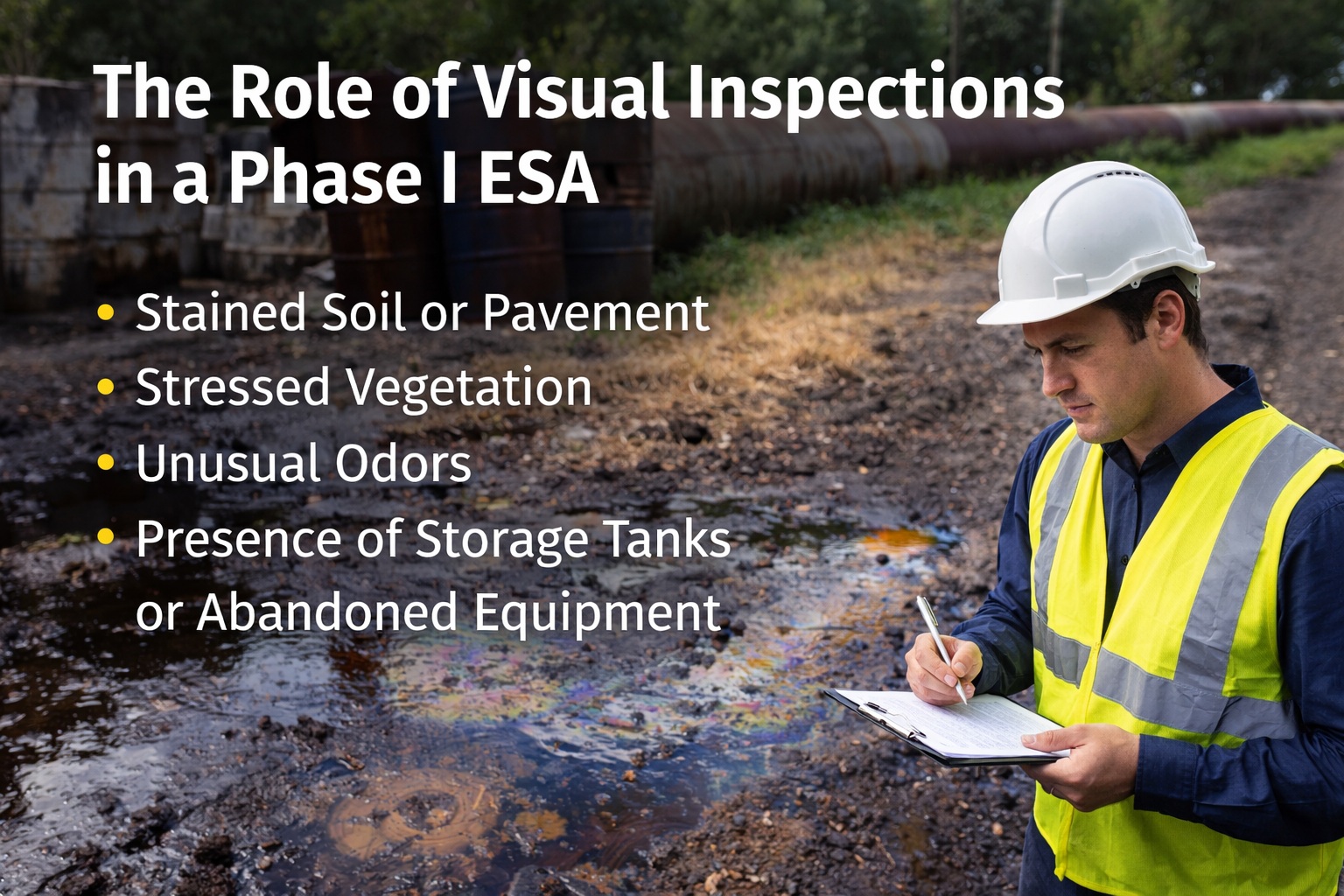
A Phase I Environmental Site Assessment (ESA) is a foundational component of environmental due diligence, conducted to identify potential or existing environmental contamination liabilities associated with a property. While historical records, regulatory database reviews, and interviews provide critical background information, visual inspections remain one of the most powerful and immediate tools available to the Environmental Professional (EP).
A thorough site reconnaissance can reveal current conditions, confirm historical uses, and uncover evidence of contamination that may not be documented elsewhere. In many cases, visual observations serve as the first indication of Recognized Environmental Conditions (RECs), guiding further investigation or the need for a Phase II ESA.
This article explores the essential role of visual inspections in a Phase I ESA, with a detailed focus on four key indicators:
- Stained soil or pavement
- Stressed vegetation
- Unusual odors
- Presence of storage tanks or abandoned equipment
Understanding the Purpose of Visual Inspections
Visual inspection, often referred to as site reconnaissance, is a required component of a Phase I ESA under ASTM E1527-21. The purpose is not to perform intrusive testing but to:
- Observe current site conditions
- Identify potential contamination indicators
- Verify historical and regulatory findings
- Evaluate surrounding properties for off-site impacts
The Environmental Professional conducts a systematic walkover of the property and adjacent areas, documenting findings with notes and photographs. These observations help determine whether environmental concerns are present and whether additional investigation is warranted.
Stained Soil or Pavement
What It Indicates
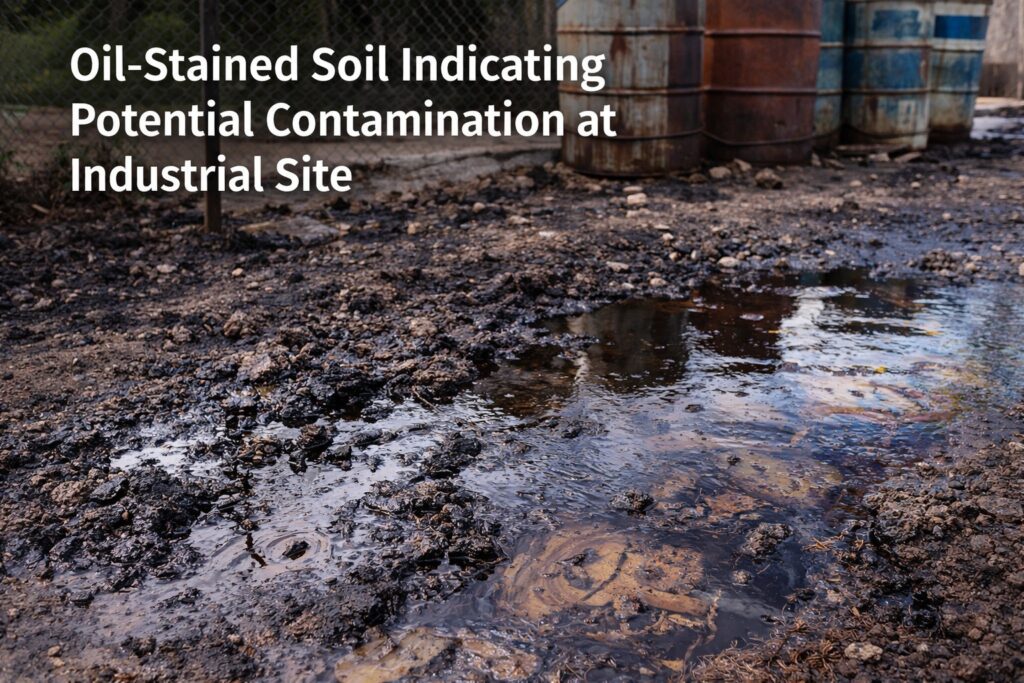
Stained soil or pavement is one of the most visible and telling indicators of potential contamination. Discoloration may result from:
- Petroleum hydrocarbons (e.g., gasoline, diesel, oil)
- Chemical spills or leaks
- Improper waste disposal
- Equipment maintenance activities
These stains often appear as dark patches, rainbow sheens, or irregular discolorations on surfaces.
Why It Matters
Such staining can signal past or ongoing releases of hazardous substances. Even if the source is no longer active, residual contamination may persist in subsurface soils or groundwater.
For example:
- A dark stain near a loading dock may suggest repeated fuel spills
- Oily patches beneath machinery could indicate chronic leaks
- Discolored soil near waste storage areas may point to improper handling
What Environmental Professionals Look For
Environmental Professionals assess:
- Location and extent of staining
- Proximity to potential sources (e.g., tanks, equipment)
- Evidence of migration (e.g., runoff patterns)
- Surface vs. subsurface implications
They also consider whether the staining appears recent or historical, which can influence risk evaluation.
Implications for Phase I ESA
If staining is observed, it may be classified as a REC or Controlled REC (CREC), depending on context. This often leads to:
- Recommendation for soil and/or groundwater sampling
- Further investigation in a Phase II ESA
- Review of spill records or cleanup documentation
Stressed Vegetation
What It Indicates
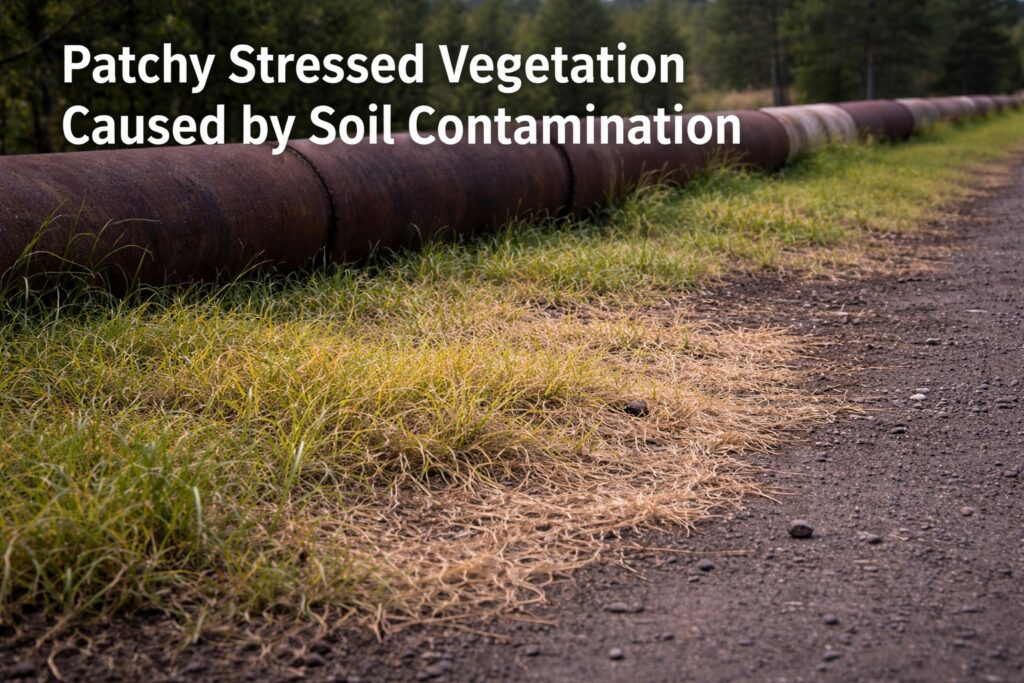
Vegetation can serve as a natural indicator of environmental conditions. Stressed or dead plants may suggest underlying contamination affecting soil quality.
Signs include:
- Yellowing or browning of leaves
- Patchy or uneven growth
- Complete absence of vegetation in localized areas
- Stunted or deformed plant growth
Causes of Vegetation Stress
While vegetation stress can result from natural factors (e.g., drought, pests), it may also be linked to:
- Petroleum contamination
- Heavy metals or toxic chemicals
- Changes in soil pH
- Salinity from industrial processes
Why It Matters
Contaminants in soil can disrupt plant root systems, nutrient uptake, and water absorption. In some cases, vegetation patterns can reveal the footprint of subsurface contamination.
For example:
- A linear strip of dead vegetation may indicate a leaking underground pipeline
- Isolated barren patches could point to localized spills
- Persistent stress in landscaped areas may suggest historical contamination
What Environmental Professionals Evaluate
Environmental Professionals consider:
- Consistency of vegetation patterns
- Correlation with known or suspected contamination sources
- Seasonal factors and alternative explanations
- Comparison with surrounding areas
Implications for Phase I ESA
While not definitive proof of contamination, stressed vegetation is a strong visual cue that warrants further scrutiny. It may lead to:
- Targeted sampling recommendations
- Inclusion as a REC if supported by additional evidence
- Integration with historical and regulatory findings
Unusual Odors

What It Indicates
Odors can provide immediate sensory evidence of contamination. During a site walkover, Environmental Professionals may detect:
- Petroleum smells (e.g., gasoline, diesel)
- Chemical or solvent odors
- Rotten egg smell (hydrogen sulfide)
- Sweet or pungent industrial scents
Why It Matters
Odors often indicate the presence of volatile or semi-volatile compounds, which may pose environmental and health risks. These compounds can originate from:
- Leaking underground storage tanks (USTs)
- Contaminated soil or groundwater
- Improper waste disposal
- Landfill gas migration
Challenges in Odor Assessment
Odor detection is subjective and can be influenced by:
- Wind direction and weather conditions
- Time of day
- Individual sensitivity
Despite these limitations, experienced Environmental Professionals can distinguish between typical site smells and those indicative of contamination.
What Environmental Professionals Look For
Environmental Professionals document:
- Type and intensity of odor
- Specific locations where odors are detected
- Correlation with potential sources
- Persistence or intermittency
Implications for Phase I ESA
Unusual odors can elevate concern, especially when combined with other indicators. They may:
- Support identification of a REC
- Trigger recommendations for vapor intrusion assessment
- Lead to Phase II investigation focusing on volatile compounds
Presence of Storage Tanks or Abandoned Equipment
What It Indicates
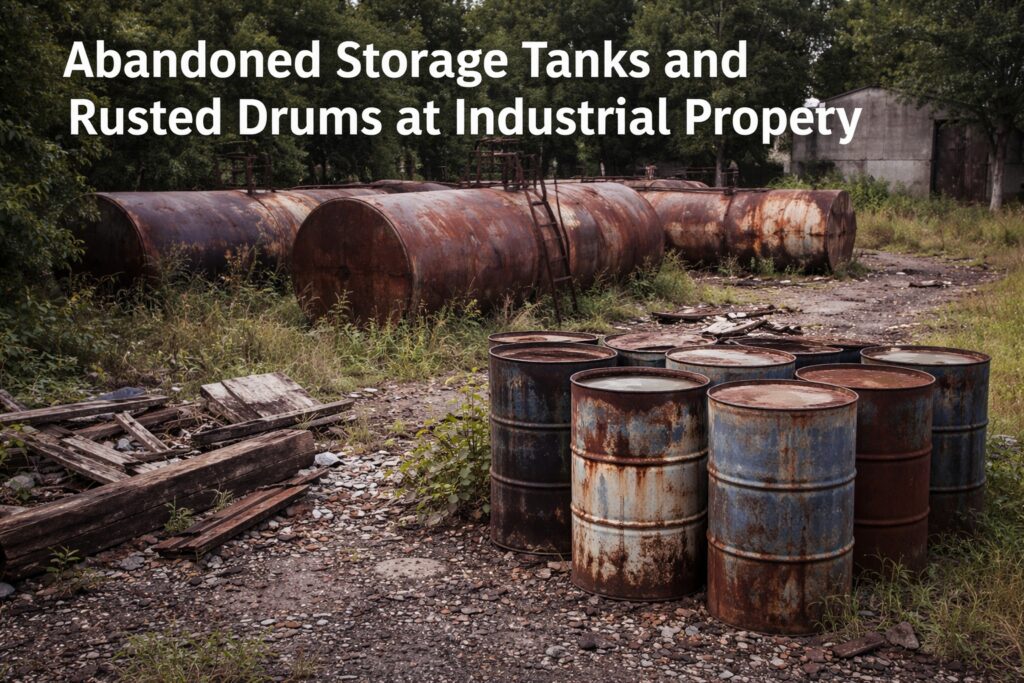
The presence of storage tanks and abandoned equipment is a critical visual indicator of potential environmental risk. These may include:
- Underground storage tanks (USTs)
- Aboveground storage tanks (ASTs)
- Drums, barrels, or containers
- Disused machinery or industrial equipment
Why It Matters
Storage tanks and equipment are common sources of contamination due to:
- Leaks and spills
- Corrosion and structural failure
- Improper decommissioning
- Unknown contents
Abandoned materials, in particular, raise concerns about unregulated or undocumented waste.
What Environmental Professionals Look For
Environmental Professionals assess:
- Condition (e.g., rust, damage, leaks)
- Labeling and identification
- Secondary containment systems
- Evidence of past removal (e.g., vent pipes, fill ports)
- Regulatory compliance indicators
They also look for indirect signs of former tanks, such as:
- Piping remnants
- Depressions in the ground
- Historical use consistent with fuel storage
Implications for Phase I ESA
The presence of tanks or abandoned equipment often leads to:
- Identification of a REC
- Review of tank registration and closure records
- Recommendation for geophysical surveys or subsurface investigation
- Potential Phase II ESA to assess soil and groundwater impacts
Integrating Visual Observations with Other Data
Visual inspections are most effective when integrated with:
- Historical aerial photographs
- Fire insurance maps
- Regulatory database records
- Interviews with site personnel
For example:
- Stained soil observed near a former fueling area identified in historical records strengthens the case for a REC
- Stressed vegetation aligned with a known pipeline route supports further investigation
This holistic approach ensures that visual findings are contextualized and validated, reducing uncertainty in the assessment.
Limitations of Visual Inspections
While invaluable, visual inspections have inherent limitations:
- Subsurface contamination may not be visible
- Weather conditions can obscure evidence
- Site access restrictions may limit observations
- Some contaminants are odorless and colorless
Therefore, visual inspection is not a substitute for sampling or testing, but rather a complementary tool that informs decision-making.
Best Practices for Effective Site Reconnaissance
To maximize the value of visual inspections, Environmental Professionals should:
- Follow a systematic and documented approach
- Use checklists aligned with ASTM standards
- Take comprehensive photographs
- Note both presence and absence of indicators
- Consider seasonal and environmental factors
- Maintain professional judgment and skepticism
Thorough documentation ensures that findings are defensible and useful for clients, regulators, and stakeholders.
The Critical Role of Professional Judgment
Ultimately, the effectiveness of a visual inspection depends on the expertise of the Environmental Professional. Recognizing subtle indicators, distinguishing between benign and concerning conditions, and integrating multiple lines of evidence require:
- Experience in environmental assessments
- Knowledge of industrial processes and contaminants
- Familiarity with regulatory frameworks
Professional judgment transforms raw observations into actionable insights.
Conclusion
Visual inspections are a cornerstone of the Phase I Environmental Site Assessment process. By identifying key indicators such as stained soil, stressed vegetation, unusual odors, and the presence of storage tanks or abandoned equipment, Environmental Professionals can uncover potential environmental risks that might otherwise go unnoticed.
These observations not only support the identification of Recognized Environmental Conditions but also guide further investigation and risk management decisions. While not without limitations, visual inspections provide immediate, cost-effective, and highly informative insights into site conditions.
In the broader context of environmental due diligence, the value of a well-executed site reconnaissance cannot be overstated. It bridges the gap between historical data and current reality, ensuring that property transactions and developments are informed by a comprehensive understanding of environmental risk.
👉 Learn more about our Automated Environmental Site Assessment Solution
Related Articles
- Overview of a Phase I Environmental Site Assessment (ESA): A Complete Guide for Due Diligence
- Key Uses of a Phase I Environmental Site Assessment
- Market for Phase I Environmental Site Assessments
- The Role of Historical Source Review in Phase I Environmental Site Assessments
- The Role of Environmental Database Reviews in Phase I Environmental Site Assessments
- The Review of Property Records in a Phase I Environmental Site Assessment
- Identifying Hazardous Substances and Petroleum Products in a Phase I Environmental Site Assessment
- Documenting Drainage Patterns and Surface Water in a Phase I Environmental Site Assessment
- The Role of Photographs in Phase I Environmental Site Assessments
- The Use of Drones in a Phase I Environmental Site Assessment
- Conducting Interviews with Property Owners and Occupants for a Phase I ESA
- Conducting Interviews with Government Officials for a Phase I ESA
- Conducting Interviews with Neighbors for a Phase I ESA
- Key Components of a Phase I ESA Conclusion
- Key Distinctions Between ASTM E1527-21 and CSA Z768-01