

Current product direction
GAEA Technologies continues to invest in practical tools that help geotechnical, environmental, geological and engineering teams manage data, improve QA/QC, modernize legacy workflows and move historical information into current systems.
This roadmap highlights recently delivered capabilities, work currently in development, and the areas we expect to focus on next.
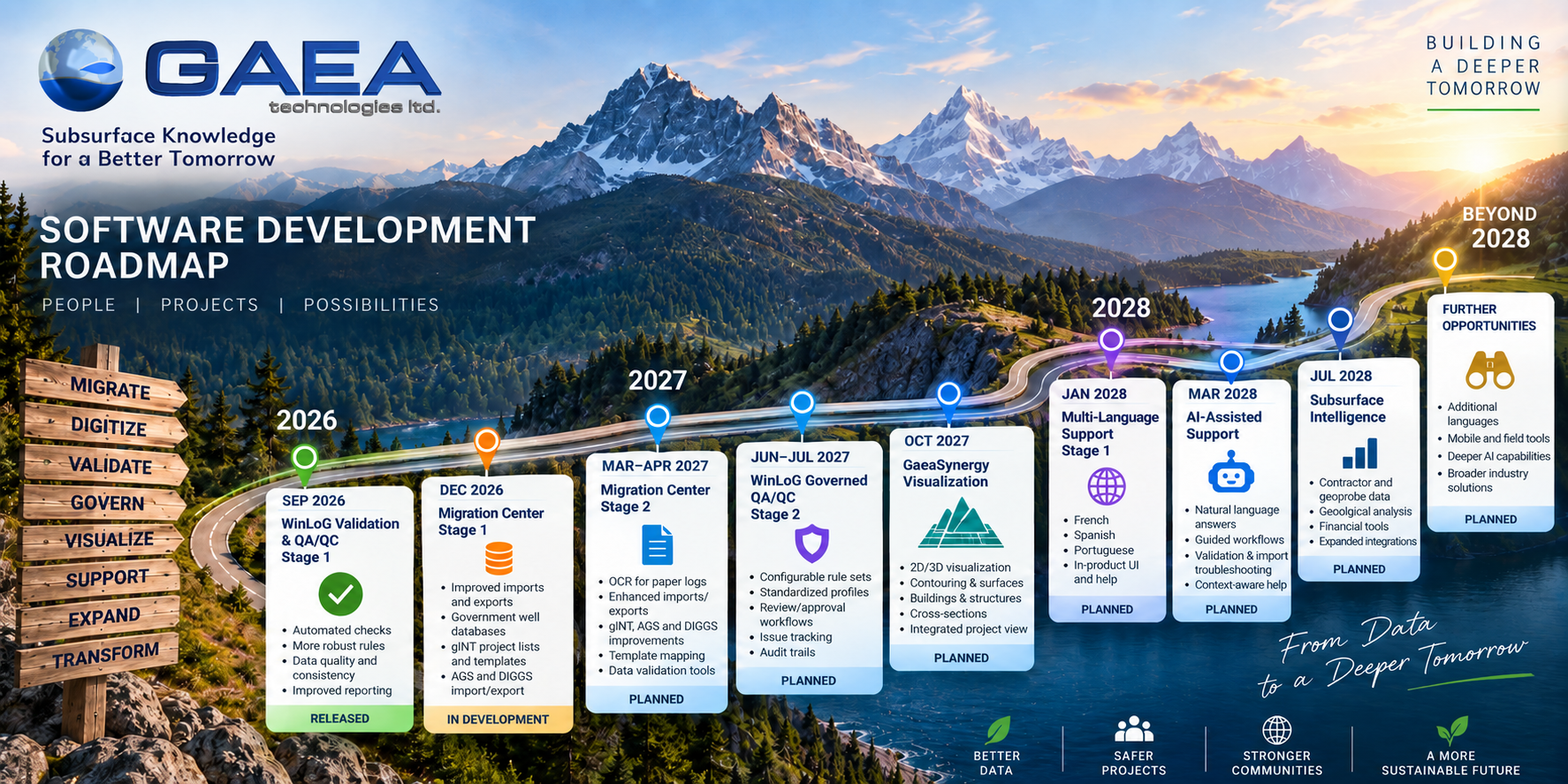
Development is organized around practical customer workflows rather than isolated features.
WinLoG Validation & QA/QC Stage 1
Migration Center Stage 1
Migration, OCR, Governed QA/QC and Visualization
AI Support, Multi-Language Support and Workflow Enhancements
Capabilities already available to customers.
WinLoG now includes automated Validation & QA/QC capabilities designed to identify data omissions, invalid values, inconsistencies and relationships that require technical review before logs are issued or exchanged.
Current development priorities targeted for the remainder of 2026.
The next stage of the Migration Center is focused on making it easier to move historical and external project information into current GAEA workflows using more consistent, guided processes.
Many organizations retain valuable project information in legacy databases, older GAEA versions, gINT projects, spreadsheets, structured exchange files and historical archives. The Migration Center is intended to reduce the friction and risk involved in bringing that information into current, reviewable workflows.
Current development direction following the 2026 migration work.
Stage 2 is expected to extend migration, conversion and interoperability capabilities using lessons from Stage 1, customer projects and additional legacy data sources.
The objective is to reduce manual re-entry while maintaining a reviewable migration process for historical and legacy information.
Stage 2 is expected to build on WinLoG's automated validation engine with stronger governance, review and accountability for organizations that need consistent QA/QC procedures across users, offices and projects.
The goal is to provide a governed process for documenting how data-quality issues are reviewed and resolved.
Planned visualization enhancements will expand how geological, geotechnical and environmental information can be reviewed together within GaeaSynergy, with a focus on clearer project interpretation and integrated spatial understanding.
The goal is to make GaeaSynergy a more effective environment for reviewing complex project information spatially and across disciplines.
GAEA plans to introduce AI-assisted support tools that help customers find answers faster while keeping product documentation, established workflows and technical support as the authoritative foundation.
AI assistance is intended to complement, not replace, GAEA's technical support.
GAEA plans to expand language support to make software, guidance and customer-facing resources more accessible to international users while preserving technical terminology and engineering context.
Initial language priorities can be guided by customer concentration, distributor needs and the regions where localized support would provide the greatest benefit.
Longer-term areas that support GAEA's international customer base and connected technical workflows.
Ongoing development will continue to focus on reducing repeated data entry, improving interoperability, simplifying migration and strengthening connections between GAEA applications and supported industry data formats.
This roadmap reflects GAEA Technologies' current development priorities and expected direction. Features, scope, sequencing and target release periods may change based on development progress, customer feedback, technical requirements and evolving industry needs.
Customer feedback plays an important role in how GAEA prioritizes migration, validation, interoperability, digitization and workflow improvements.
Tell us about the legacy applications, project databases, paper records or structured data your organization needs to preserve and modernize.

GAEA Technologies develops and distributes geoscience and engineering solutions worldwide. Our solutions have been used for over 30 years by companies and organizations around the world.
© 2026 GAEA Technologies. All Rights Reserved.