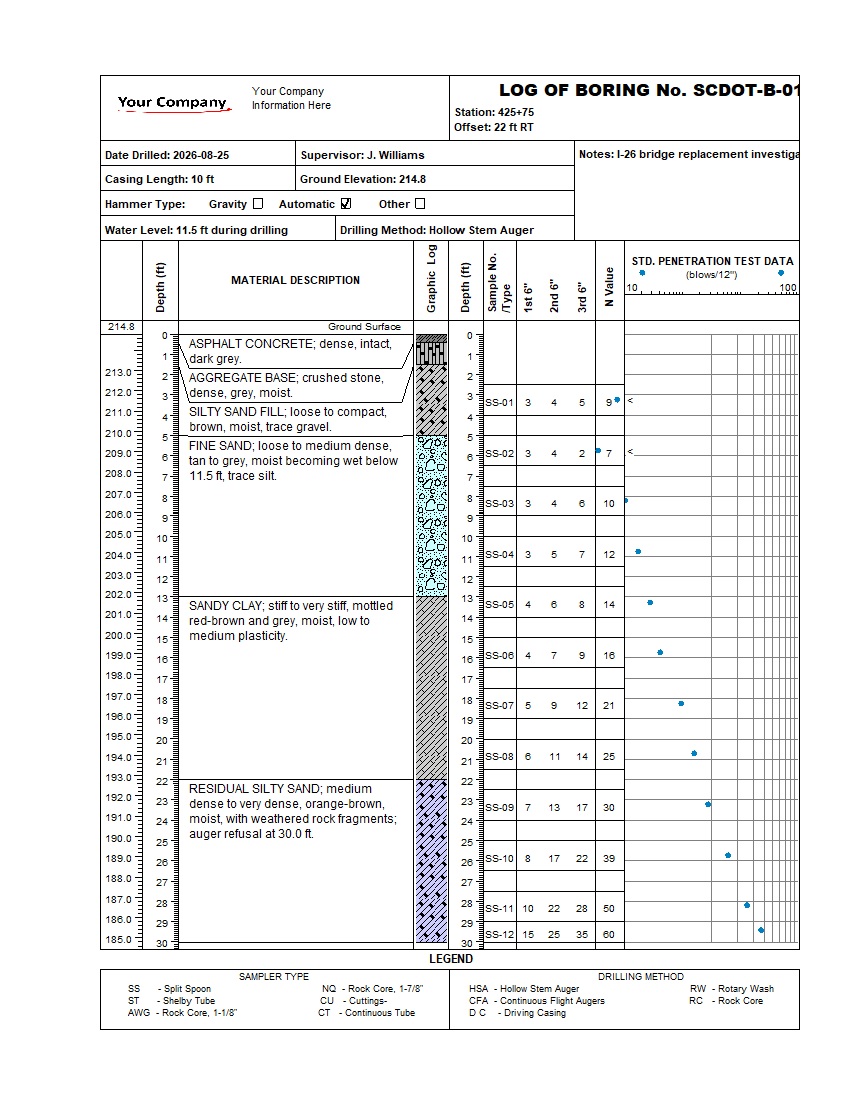
A complete South Carolina DOT-style transportation boring with pavement, roadway fill, soil descriptions, split-spoon samples, individual blow increments, calculated N-values, groundwater, elevations, and an SPT resistance plot.
SCDOT-B-01 I-26 Bridge Replacement demonstrates how WinLoG presents field investigation data for a highway bridge project. The 30 ft boring records asphalt and aggregate base over fill, coastal plain soils, residual materials, and progressively increasing penetration resistance.
The native SCDOT-style layout combines a continuous material profile with sample depths, sample identifiers, three 6-inch blow-count increments, SPT N-values, and a logarithmic resistance graph. Automated validation passes with 100% completeness, Good quality, 85% confidence, and no errors or warnings.
The profile begins with asphalt concrete and aggregate base, passes through silty sand fill and fine sand, then transitions into stiff sandy clay and increasingly dense residual silty sand. The sequence demonstrates how roadway construction materials and native subsurface conditions can be reviewed on a single depth-aligned record.
The validation report records Passed status, 100% completeness, Good quality, an 85% confidence score, and zero errors and zero warnings.
Download the example files individually. The XML template and boring log can be imported into WinLoG Version 6 and customized for DOT, highway, bridge, and other transportation investigations.
Shows an agency-oriented boring format for roadway, bridge, culvert, widening, and rehabilitation investigations.
Demonstrates coordinated pavement, lithology, sampling, groundwater, penetration-resistance, station, offset, and drilling information.
Provides a consistent record for checking blow increments, calculated N-values, sample depths, stratigraphic transitions, and completeness.
WinLoG templates can be customized for company standards, project requirements, and agency formats. Headers, stationing, sampling columns, SPT graphs, lithology, legends, and validation rules can all be tailored to transportation workflows.
Contact GAEA Technologies
GAEA Technologies develops and distributes geoscience and engineering solutions worldwide. Our solutions have been used for over 30 years by companies and organizations around the world.
© 2026 - All Rights Reserved/span>