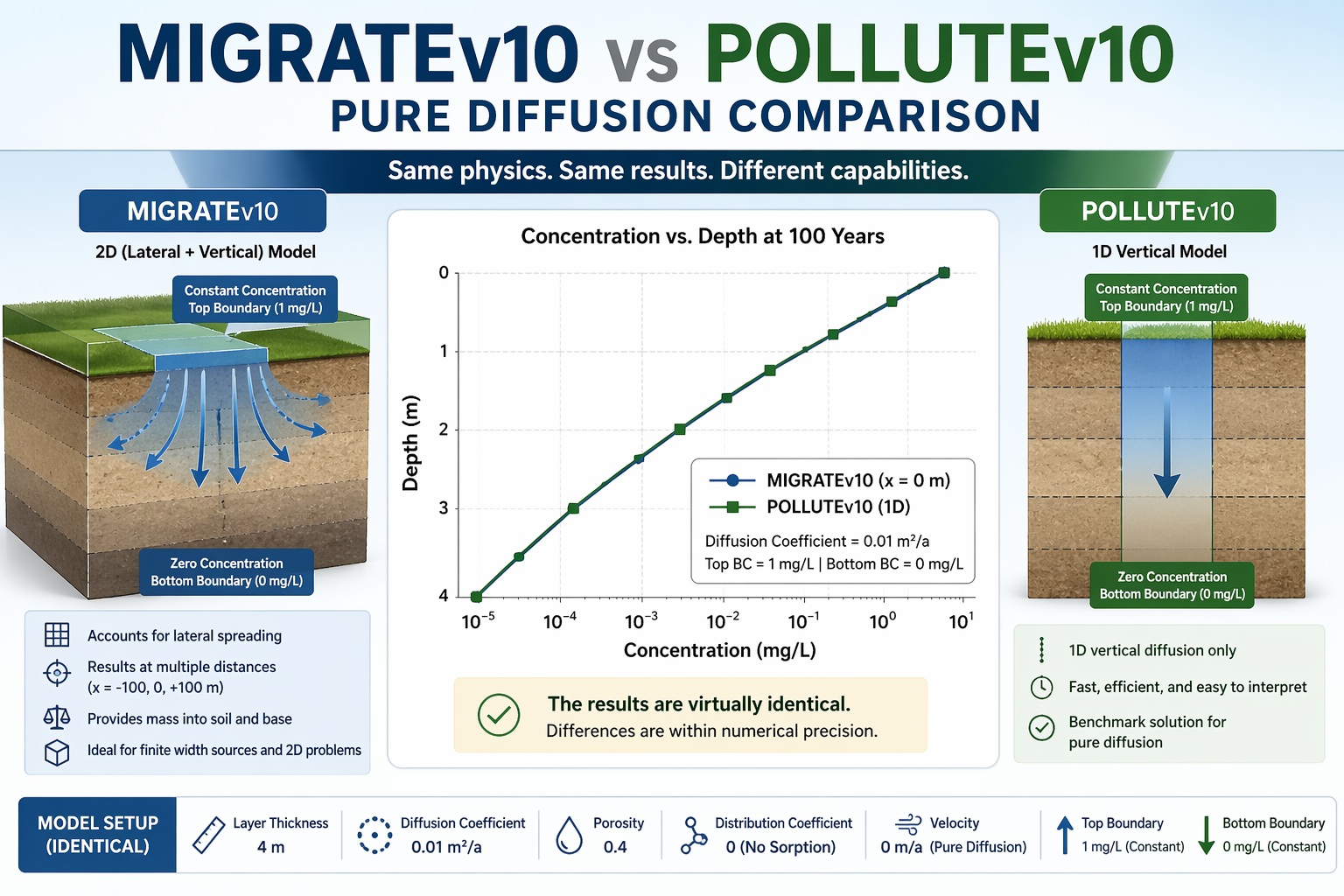
Pure Diffusion Comparison
Uses identical 4 m diffusion-only models to verify close agreement when lateral spreading does not affect the solution.
Open documented comparison

Begin with matched diffusion and advection cases, then examine finite sources, hydraulic trapping and fractured media with sorption.
Each comparison uses equivalent physical conditions to separate transport behavior from the effect of dimensionality: POLLUTE’s 1D/1.5D formulation and MIGRATE’s explicit 2D representation.
Start with pure diffusion to verify the common physics, then add flow, source depletion, opposing gradients and fractured transport.
Showing 5 comparisons
Uses identical 4 m diffusion-only models to verify close agreement when lateral spreading does not affect the solution.
Open documented comparison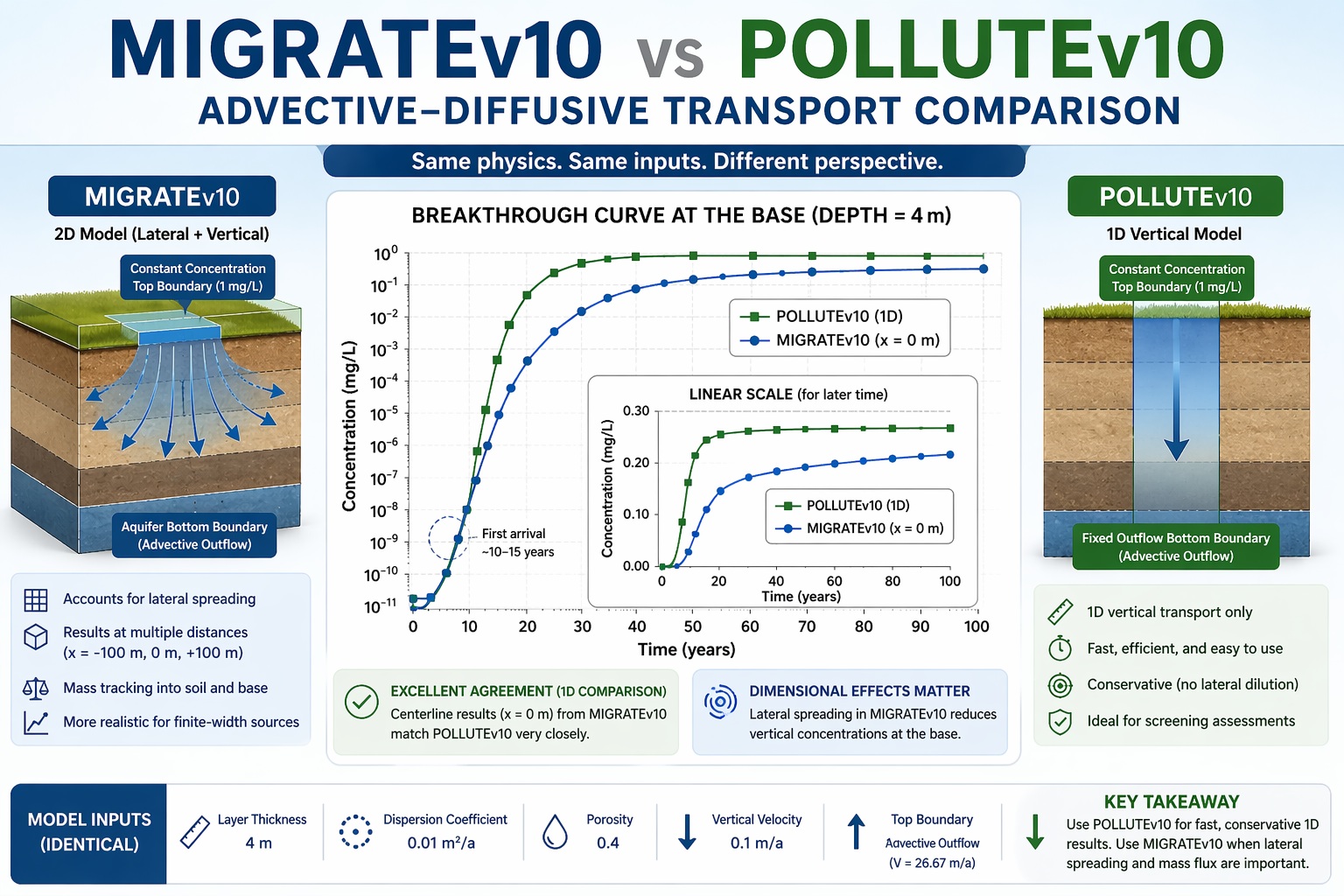
Adds downward velocity and aquifer outflow, producing rapid breakthrough and closely matching centerline profiles.
Open documented comparison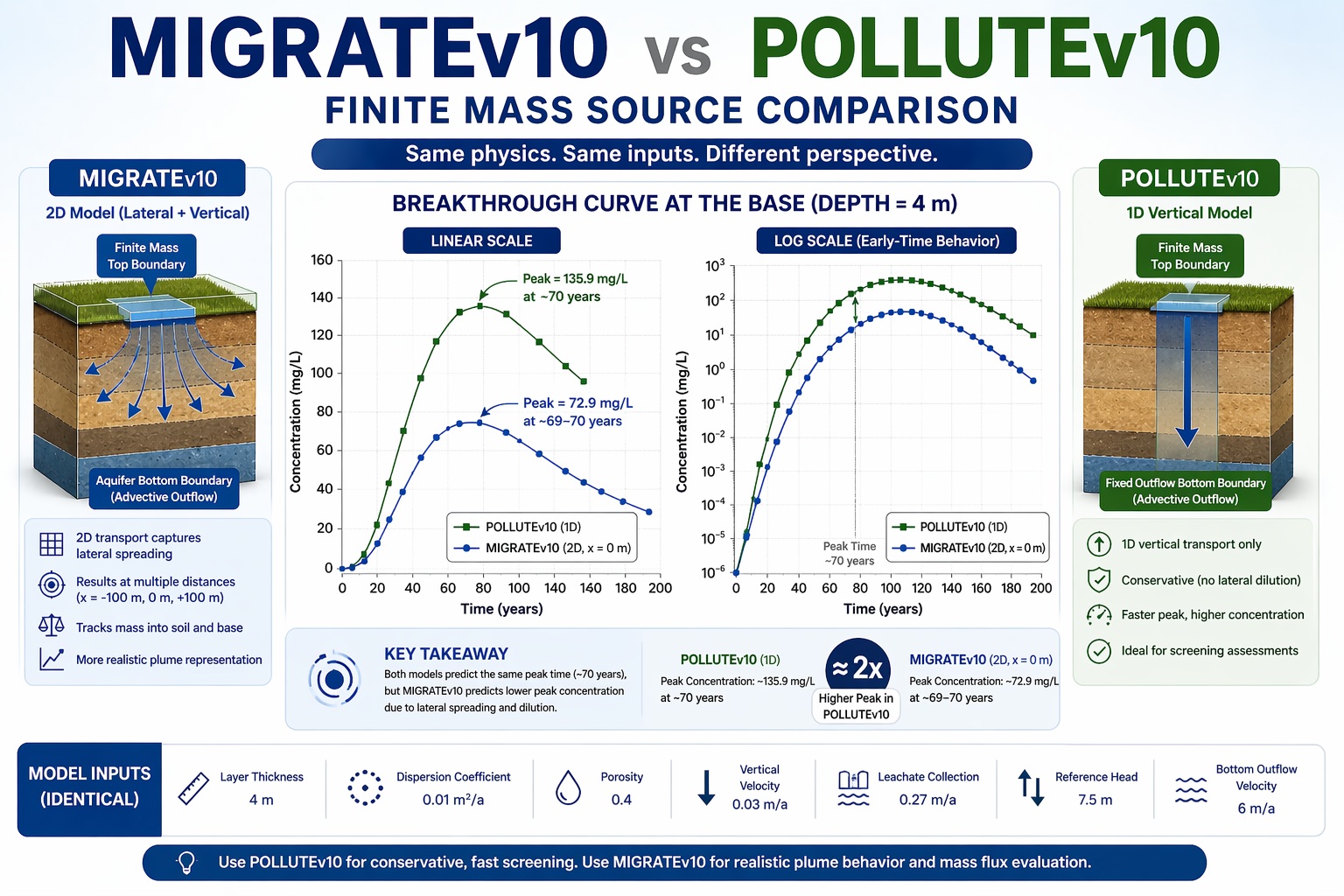
Compares peak timing and magnitude as a limited source depletes and MIGRATE distributes mass laterally.
Open documented comparison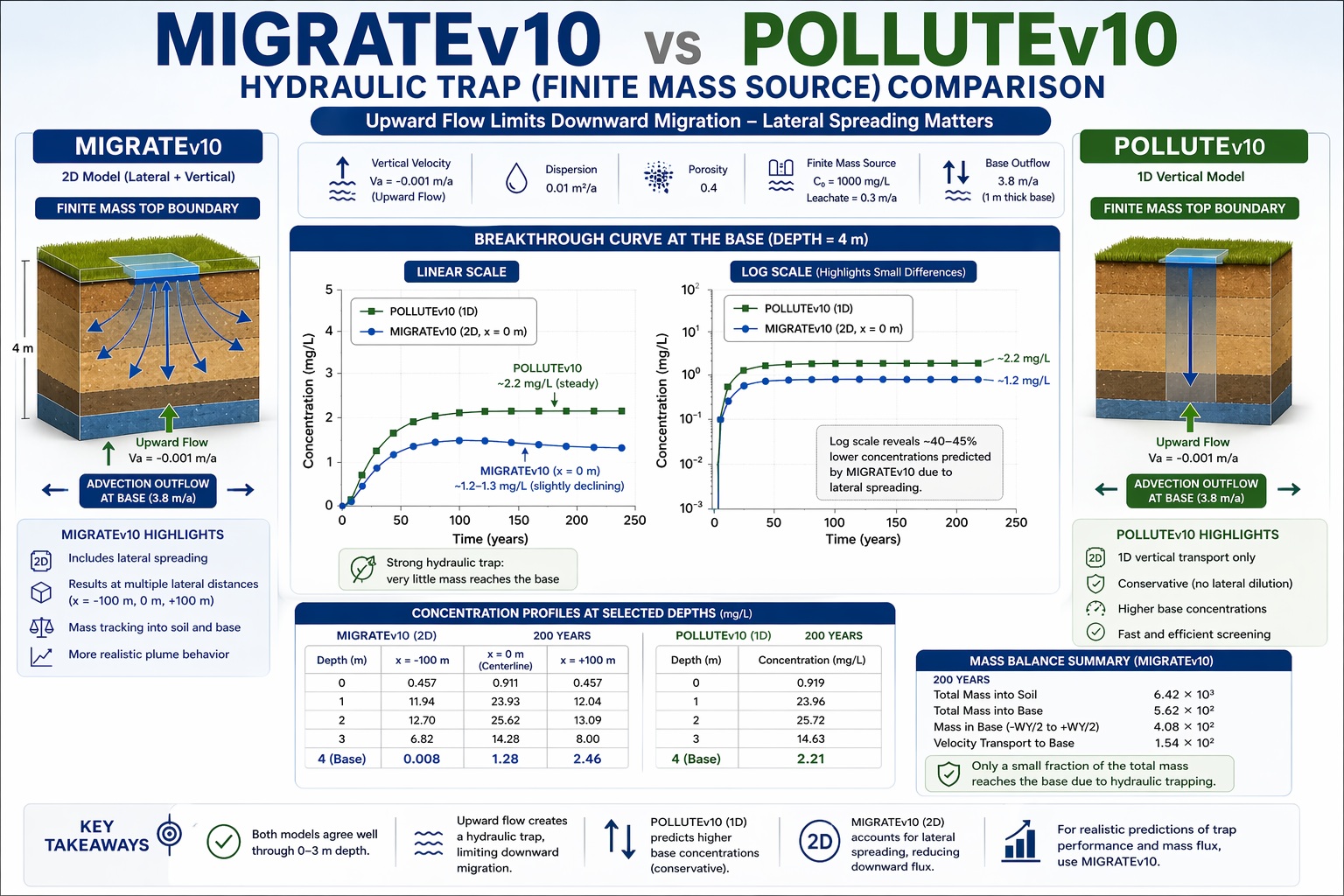
Examines upward flow opposing downward migration and changing the breakthrough response in both formulations.
Open documented comparison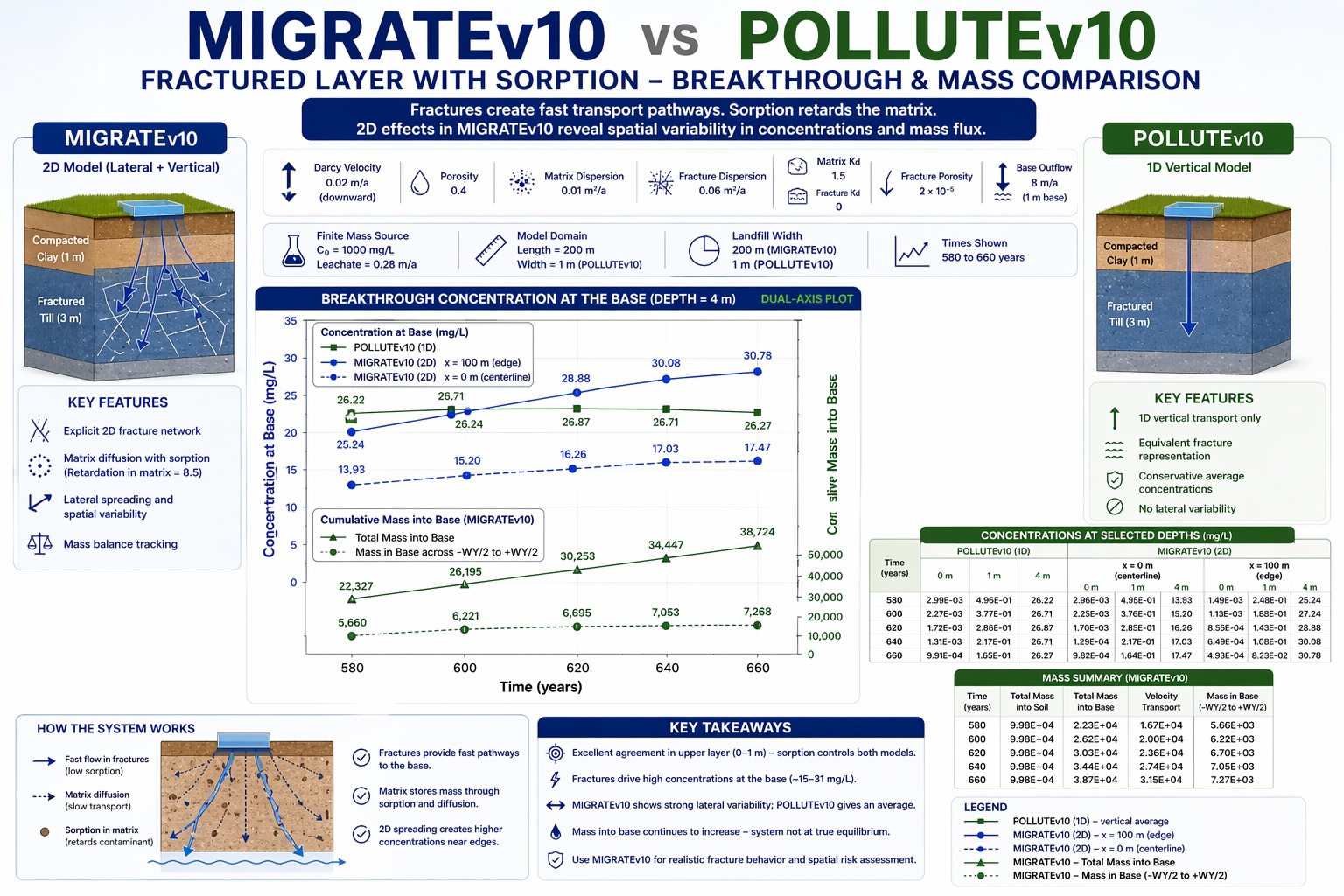
Combines fracture flow, matrix diffusion and sorption to show agreement in upper layers and spatial variability at depth.
Open documented comparisonUse Pure Diffusion to confirm that the matched models produce nearly identical profiles under simple conditions.
Use Advective–Diffusive Transport to compare rapid breakthrough and centerline agreement.
Compare Finite Mass and Hydraulic Trap cases to examine peaks, depletion and opposing flow.
Use the Fractured Layer case to see how MIGRATE reveals lateral variability hidden by a 1D average.
Review the layered 1D/1.5D formulation, sources, boundaries and engineering outputs.
Explore POLLUTE FeaturesReview two-dimensional geometry, multiple sources, fractured media and spatial results.
Explore MIGRATE FeaturesOpen the original articles with detailed parameters, tables, plots and interpretation.
Open the archiveExplore 20 progressive layered contaminant-transport examples.
Browse POLLUTE ExamplesExplore 13 progressive two-dimensional contaminant-transport examples.
Browse MIGRATE ExamplesAsk about formulation selection, model configuration or product evaluation.
Contact Technical SupportReproduce a matched case, verify the common physics and then decide whether the project requires conservative layered screening or explicit spatial behavior.

GAEA Technologies develops and distributes geoscience and engineering solutions worldwide. Our solutions have been used for over 30 years by companies and organizations around the world.
© 2026 GAEA Technologies. All Rights Reserved.