

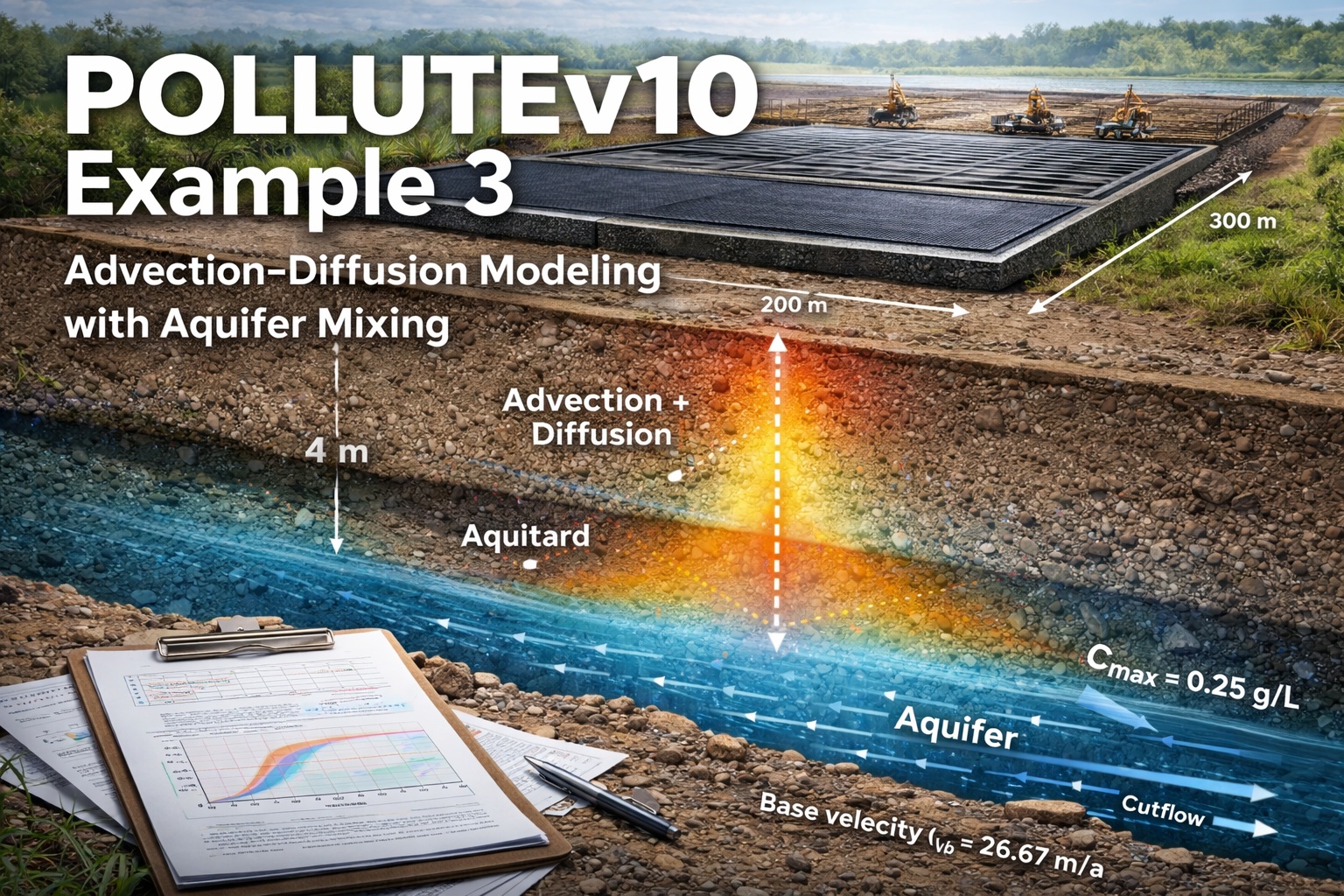
This example builds directly on Example 2 by introducing advective transport and a permeable aquifer boundary. This scenario is much closer to real-world landfill hydrogeology, where both diffusion and groundwater flow control contaminant migration.
Overview of the Scenario
In this example, the system consists of:
- A 4 m thick aquitard (low permeability layer)
- A constant contaminant source at the top (landfill)
- A 3 m thick active aquifer zone (upper portion of a 20 m aquifer)
- Downward flow (advection) through the aquitard
- Mixing in the aquifer controlled by flow continuity
Key Enhancements from Example 2:
- ✅ Advection included (va ≠ 0)
- ✅ Aquifer explicitly represented as a boundary
- ✅ Flow continuity used to calculate dilution
- ❌ Still no sorption (Kd = 0)
Conceptual Model
The transport system includes:
- Downward advection + diffusion through aquitard
- Mass transfer into aquifer at 4 m depth
- Dilution in flowing groundwater system
The aquifer is treated as a well-mixed receptor zone, not a full 3D domain.
Input Parameters
| Property | Symbol | Value | Units |
|---|---|---|---|
| Darcy Velocity | va | 0.1 | m/a |
| Diffusion Coefficient | D | 0.01 | m²/a |
| Distribution Coefficient | Kd | 0 | cm³/g |
| Soil Porosity | n | 0.4 | – |
| Dry Density | ρd | 1.5 | g/cm³ |
| Aquitard Thickness | H | 4 | m |
| Sub-layers | – | 4 | – |
| Source Concentration | c₀ | 1 | g/L |
| Landfill Length | L | 200 | m |
| Landfill Width | W | 300 | m |
| Aquifer Thickness | h | 3 | m |
| Aquifer Porosity | nb | 0.3 | – |
| Base Outflow Velocity | vb | 26.67 | m/a |
Governing Transport Equation
With both advection and diffusion:
∂t∂C+va∂x∂C=D∂x2∂2C
This equation shows:
- Advection term (va ∂C/∂x) → dominates transport
- Diffusion term (D ∂²C/∂x²) → smooths gradients
Flow Continuity Calculations
A key part of this example is determining the aquifer dilution using flow balance.
1. Inflow to Aquifer (Upgradient)
2. Flow from Landfill (Recharge)
3. Total Outflow
4. Base Outflow Velocity
Peak Concentration (Hand Calculation)
Because advection dominates, the peak aquifer concentration can be estimated:
✔ Key Insight:
- The aquifer concentration is controlled by dilution, not diffusion
- This provides a quick validation check against model results
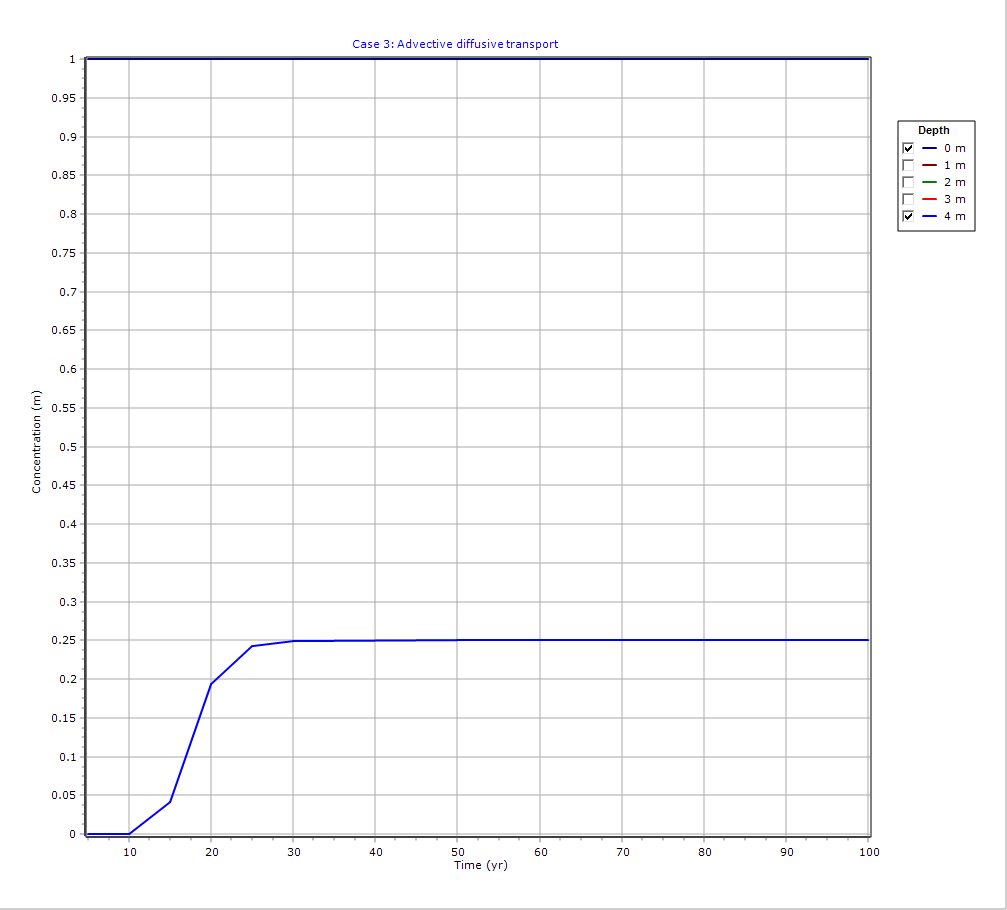
Graphical Output: Concentration vs Time
PDF Report
 Loading…

 Reload document
  Open in new tab
 Key Results
- Peak aquifer concentration: 0.25 g/L
- Transport dominated by advection
- Dilution governed by flow continuity
Conclusions
- Advection significantly increases contaminant migration rate
- Aquifer dilution is critical in determining impact
- Simple hand calculations can approximate peak concentrations
- Model highlights importance of accurate hydrogeologic characterization
Engineering Warning
The parameter vb (base outflow velocity) must be carefully evaluated:
- Depends on:
- Aquifer transmissivity
- Hydraulic gradients
- Landfill recharge
- In complex systems:
- Numerical groundwater models may be required
- Simple continuity assumptions may not be sufficient
Key Engineering Insights
- This example bridges the gap between:
- Pure diffusion (Example 2)
- Real-world transport systems
- Demonstrates:
- Importance of flow systems
- Sensitivity to Darcy velocity
- Role of aquifer thickness in dilution
Applications
- Landfill impact assessments
- Groundwater risk evaluation
- Regulatory compliance modeling
- Hydrogeologic sensitivity analysis
Learn more about our Contaminant Transport Modeling Solutions
POLLUTE Examples
- POLLUTEv10 Example 1: Modeling a U.S. RCRA Subtitle D Landfill
- POLLUTEv10 Example 2: Pure Diffusion in a Soil Layer (No Sorption)
- POLLUTEv10 Example 4: Finite Mass Source with Leachate Collection System
- POLLUTEv10 Example 5: Hydraulic Trap (Upward Flow into the Landfill)
- POLLUTEv10 Example 6: Fractured Layer with Sorption and Reactive Transport
- POLLUTEv10 Example 7: Lateral Migration of a Radioactive Contaminant in Fractured Rock
- POLLUTEv10 Example 8: Laboratory Diffusion of Potassium in Clay
- POLLUTEv10 Example 9: Diffusion with Freundlich Non-Linear Sorption (Phenol in Clay)
- POLLUTEv10 Example 10: Time-Varying Advective–Dispersive Transport from a Landfill
- POLLUTEv10 Example 11: Time-Varying Source Concentration with Diffusion (Chloride in Clay)
- POLLUTEv10 Example 12: Fractured Media Transport vs Analytical Solution (Tang et al., 1981)
- POLLUTEv10 Example 13: 2D Plane Dispersion vs Analytical Solution (TDAST)
- POLLUTEv10 Example 14: Modeling a Landfill with Primary and Secondary Leachate Collection Using Passive Sink
- POLLUTEv10 Example 15: Modeling Leachate Collection System Failure Using Variable Properties and Passive Sink
- POLLUTEv10 Example 16: Monte Carlo Simulation of Leachate Collection System Failure Timing
- POLLUTEv10 Example 17: Modeling a Landfill with Composite Liners and Dual Leachate Collection Systems
- POLLUTEv10 Example 18: Modeling Phase Change in a Secondary Leachate Collection System
- POLLUTEv10 Example 19: Multiphase Diffusion of Toluene Through a Geomembrane System
- POLLUTEv10 Example 20: Sensitivity Analysis of Primary Leachate Collection System Failure
Comparison between POLLUTE and MIGRATE
- MIGRATEv10 vs POLLUTEv10: Pure Diffusion Comparison
- MIGRATEv10 vs POLLUTEv10: Advective–Diffusive Transport Comparison
- MIGRATEv10 vs POLLUTEv10: Finite Mass Source Comparison
- MIGRATEv10 vs POLLUTEv10: Hydraulic Trap (Finite Mass Source) Comparison
- MIGRATEv10 vs POLLUTEv10: Fractured Layer with Sorption Comparison